
What is Marketing ROI and How Do You Measure It?
Master marketing ROI calculation: Learn formulas, CLV integration, attribution, benchmarks & optimize for growth.
The Core Marketing ROI Calculation and Why It Matters
Measuring marketing is not just about keeping books. It shows if your business is growing or just busy. Marketing ROI calculation shows how much profit you make for every dollar you spend.
Many owners think marketing is just a cost. They think it is like paying rent. But a basic formula to calculate ROI changes that. It makes marketing bring in money. It is like a machine. You put money in. More money comes out.
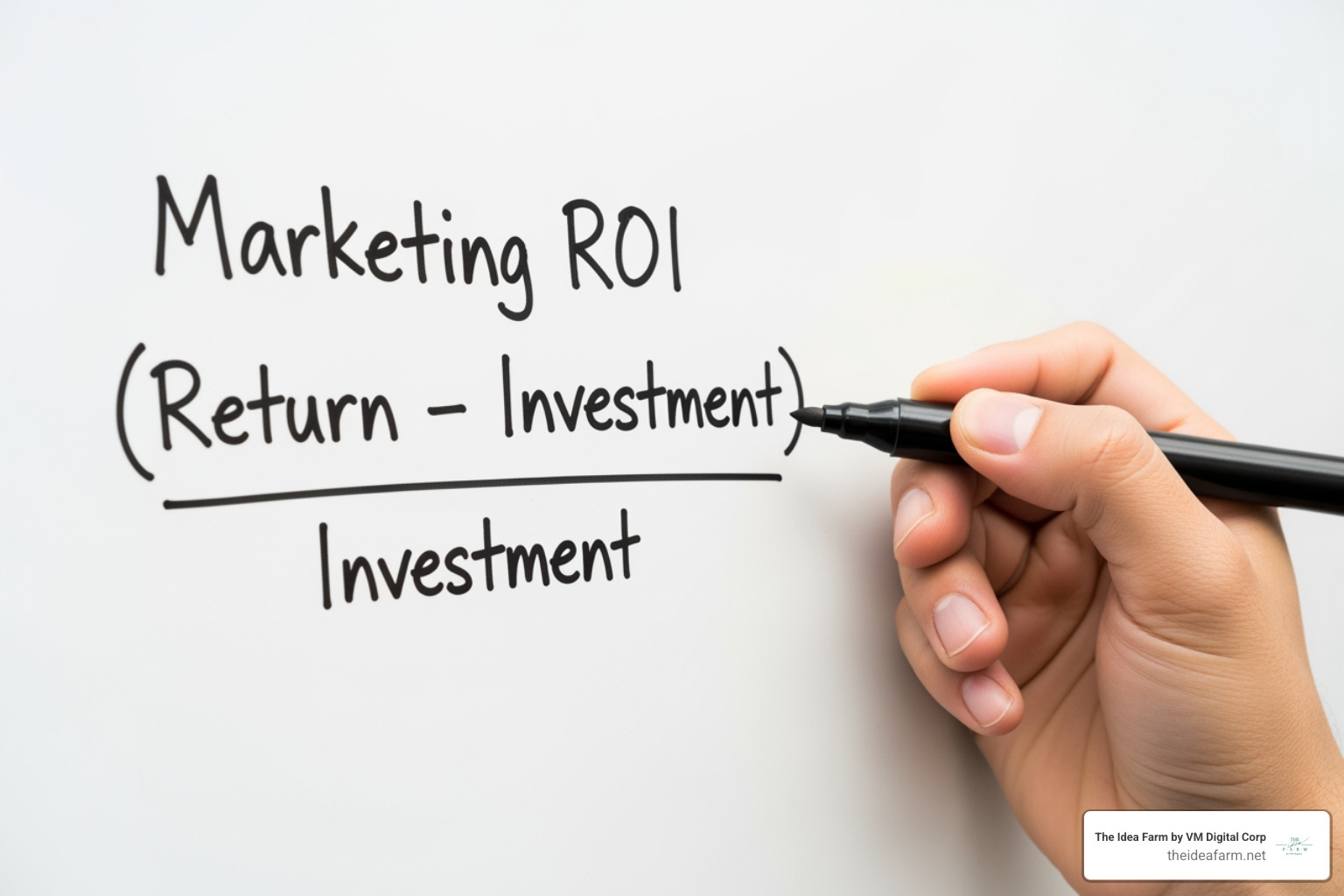
The basic formula is:(Revenue - Marketing Cost) / Marketing Cost = ROI
To get a percentage, multiply by 100. If you spend $1,000 to make $5,000, your ROI is 400%. This number is very important for your growth plan. It tells you if your ads are worth it.
Simple ROI vs. Campaign Attributable ROI
Not all sales are the same. Simple ROI says all new sales came from ads. But that is not always true. Maybe you have been in business for ten years. You already have fans. Some people would buy even without ads.
Campaign Attributable ROI is better. It is more honest. It takes away sales you would have made anyway. Then it does the math.
| Feature | Simple ROI | Campaign Attributable ROI |
|---|---|---|
| How to do it | (Total Sales Growth - Cost) / Cost | (Sales Growth - Organic Growth - Cost) / Cost |
| How right it is | Low. It makes ads look too good. | High. It shows the real value. |
| When to use it | Good for new businesses. | Good for old businesses with fans. |
| What you get | Looks better on paper. | Shows the truth. |
Advanced Formulas for Accurate Measurement
To grow your business, look at more than just sales. Sales are good. But profit pays the bills. Use profit instead of sales to be smart. This counts the cost to make the product.
If a product costs $100 but costs $60 to make, your return is $40. The Better Way to Calculate the ROI of Your Marketing Investment looks at extra profit. It does not just look at sales. This stops you from spending money on ads that lose money.
Accounting for Organic Growth in Marketing ROI Calculation
To get a true marketing ROI calculation, find a starting point. Look at months when you did not run ads. If sales grow 4% on their own, take that 4% out of your math. If you do not do this, you might think ads are better than they are. We want to know what the ads added to the business.
Including All Costs in Your Marketing Investment
Do not hide costs. Count every penny. Your marketing ROI calculation needs these:
- Media Spend: Money for digital ads.
- Creative Costs: Money for writers or artists.
- Software Tools: Money for your computer tools.
- Salaries: Money for the people doing the work.
If you spend $5,000 on ads and $5,000 on a worker, you spent $10,000. If you forget the worker, your ROI looks too good. That is how businesses lose money.
Integrating Customer Lifetime Value into Your Strategy
Marketing is not just the first sale. It is about the whole relationship. We look at Customer Lifetime Value (CLV). CLV is all the money a customer spends with you over time.

A customer might buy a $50 item today. If they come back every month for three years, they are worth $1,800. If it cost $100 to get them, simple math says you lost $50. But CLV math shows you made a big profit.
Using CLV for a Better Marketing ROI Calculation
We use the LTV:CAC ratio.
- LTV: Lifetime Value
- CAC: Customer Acquisition Cost
A good ratio is 3:1. This means the customer is worth three times what you spent to get them. If it is 1:1, you are not making money. You will run out of cash. If it is 5:1, you should spend more to grow fast.
We use our CRM and reporting to see these numbers. This shows how marketing works over a long time.
Overcoming Data Silos and Attribution Challenges
A 'data silo' is bad for your marketing ROI calculation. This happens when your data is in many different places. The places do not talk to each other. To maximize your ROI, put all data in one place.

Connect your systems. Then you can see the whole path a customer takes. We use special links to track this path. Without these, you might think your blog is bad. But the blog might be why people trust you.
Measuring ROI Across Multiple Channels
Every channel takes a different amount of time.
- Paid Ads: High cost. Fast results. Easy to track.
- SEO: Low cost. Takes 6 to 12 months to work.
- Content: Builds trust over time.
You need website systems to track these paths. For SEO, we look at ROI over a year. You pay now, but you get sales for a long time.
Benchmarks and Optimization: What is a Good ROI?
What is a good goal? A 5:1 ratio is very good for most businesses.
- 2:1 ROI: You are barely making money after you pay for work.
- 5:1 ROI: You are growing. Your marketing is doing well.
- 10:1 ROI: You are making a lot of money. Spend more now.
If a campaign is 10:1, move your money there. This is how you get better. Do not just set your budget and leave it. Move money to where it works best. There are five more approaches to measure the ROI if you want to be technical. The goal is to stop guessing. Start knowing.
Frequently Asked Questions about Marketing ROI
What is a good LTV:CAC ratio?
A good ratio is 3:1. For every $1 you spend, you get $3 back over time. If it is lower, you may need to keep customers longer. Or you can raise prices.
How long should I wait for SEO ROI?
SEO takes time. Wait 6 to 12 months to check the ROI. But you can track traffic in the first few months. This shows if you are doing well.
Can I find ROI for brand ads?
Yes, but it is hard. You can look at how many people search for your name. These are important for growth. But they are hard to put in a marketing ROI calculation.
Conclusion
At The Idea Farm, we like systems. We do not just guess. Your growth depends on using data to make choices. A good marketing ROI calculation is the first step to growth. It shows what works. It shows what does not work. You can grow with confidence. You will not have to wonder if marketing works. You will have the numbers.
Are you tired of guessing? We can help. Our fractional CMO services give you a plan. We use data to help you grow. Stop guessing. Start growing.